As a wormhole corp, we need to extract all possible information from wormholes, both to survive and to thrive in them.
¶ System Type
When you jump through a newly scanned wormhole, the mapper will prompt you to select the system you came from. Once confirmed, it will automatically display the system type, its destination, and other key details. However, it's also possible to extract a wealth of information without actually jumping through—allowing you to assess the connection safely and strategically.
¶ Visual Identification
Just by looking at the WH, we can already extract some intel like:
- Ship size restrictions – The visual effect of the wormhole indicates the largest ship class that can pass through (Frigate, Cruiser, Battleship, etc.).
- Destination type – The color and visual distortions give hints about whether it leads to highsec, lowsec, nullsec, or another wormhole system.
- Stability (lifetime left) – A flickering or dimming wormhole suggests it is nearing collapse.
- Mass remaining – The size of the wormhole’s animation can indicate how much mass has passed through and how close it is to collapsing.
But Eve University already covers this in dept, so we recommend this Eve Uni article.
¶ Information window
Information is power, so it's important to always check it when you have a wormhole in grid.
¶ Wormhole Type
Every wormhole have two sides, a entrance and a exit. The exit type will always be K162, so you will need to jump to get information about it, or be restricted to the visual infos.
The other types of wormholes can be identified using this table.
The Mapper can identify automatically the wormhole type if you feed it, or you can use this tool as well for extra information.
¶ Description
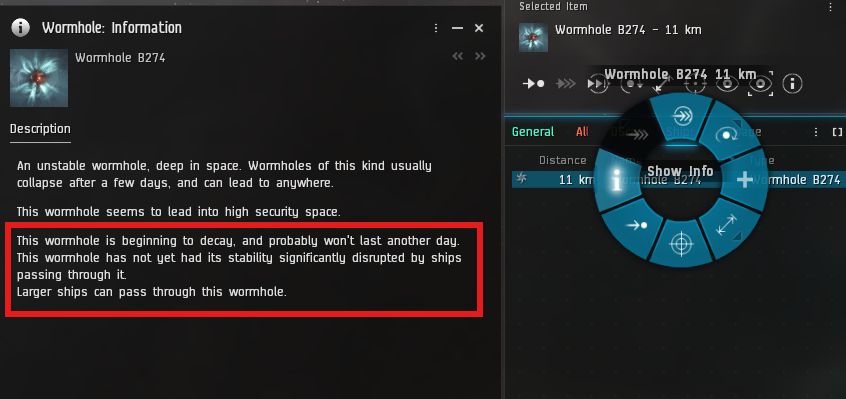
The description on the wormhole information window also gives lots of clues of it's status. And again, Eve University has it covered here.
But the two most important infos we should be checking every time we go through a wormhole are:
- Life
| not yet begun | more than 24 hours | Fresh |
| beginning to decay | between 4 and 24 hours | Fresh |
| reaching the end | less than 4 hours | EOL |
- Mass
| not yet | over 50% | Fresh |
| not to a critical degree | between 50% and 10% | Shrink |
| stability critically disrupted | less than 10% | Verge |
¶ Wormhole K162
Every wormhole system has at least one static wormhole. This means that when the static collapses, a new one will immediately spawn somewhere in the system, always leading to another system of the same class.
When this happens, we know for certain that the new wormhole is not a K162, since K162s are always the exit side of a connection. This is useful intel, but there’s another important mechanic to consider.
¶ How K162s Spawn
When a new wormhole forms, only the entry side exists at first. The exit (K162) doesn’t spawn immediately—it only appears under specific conditions, as outlined in the flowchart below.
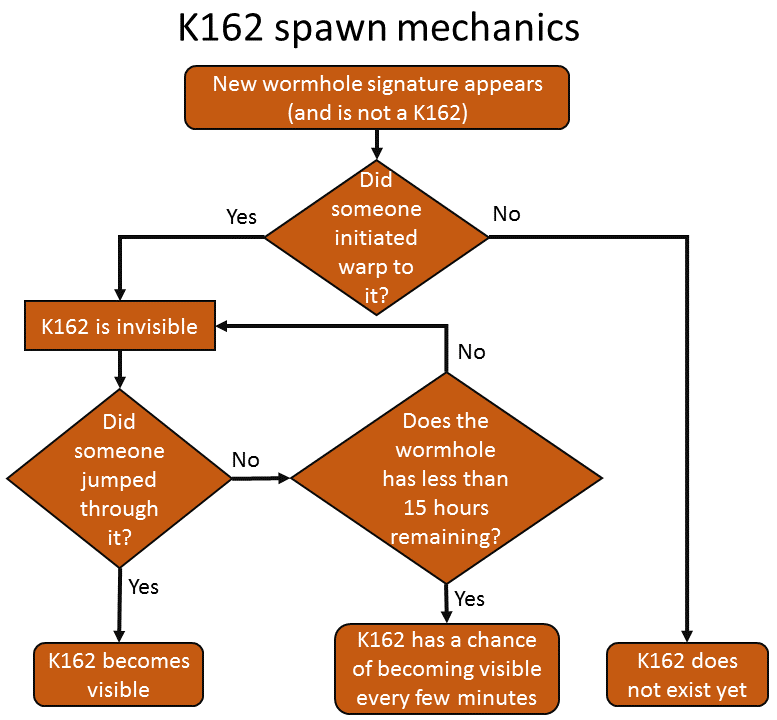
It's important to note that the K162 wormhole itself exists, but the signature leading to it does not until certain conditions are met. This usually doesn’t matter—except in C5 and C6 space, where Drifters can warp to a K162 even if its signature hasn’t spawned yet. By combat probing the Drifter, you can locate and bookmark the "unspawned" K162, allowing you to jump through before the sig appears.
¶ Why Does This Matter?
This knowledge is crucial for controlled isolation when needed. By understanding how wormhole signatures spawn, we can limit external access and reduce the risk of unwanted visitors. However, for this to work, everyone inside the wormhole must follow protocol—nobody should warp to, or even initiate warp to, any wormhole when the corp is in lockdown.